
Carpet Installation Cost in Utah: Per Square Foot, Room, and Home
The quote lands in your inbox as one number, flat and confident, and you stare at it wondering what it actually buys. Or maybe your moment comes earlier: you walk the hallway barefoot on a Saturday morning and feel the matted traffic lane running from the front door to the kitchen, the spot where years of boots, dogs, and vacuum passes have pressed the pile down to nothing. Either way, you have started pricing new carpet, and carpet installation cost is one of those numbers that seems simple until you try to compare it. Current market prices for installed carpet run about $3 to $11 per square foot nationally, depending on carpet grade, padding, removal, stairs, and prep. The per-square-foot number alone tells you very little until you know what sits behind it, so this article walks through how carpet installation is actually priced: grade, padding, removal, subfloor repair, room math, and how to read the quote line by line.
Carpet Installation Cost Per Square Foot: Typical Market Prices
Here is what published market data says right now. These are typical national market ranges, not our prices and not a quote, because a real number requires measuring the room, checking the subfloor, and planning the seams in person.
Typical installed range: about $3 to $11 per square foot. Angi's 2026 carpet cost data puts carpet installation at $3 to $11 per square foot for carpet, padding, and labor, based on thousands of verified projects. Basic fibers in spare rooms and low-traffic spaces sit toward the bottom of that range.
Basic mid-range work: about $5.27 to $7.72 per square foot. Homewyse's carpet installation estimate puts the national average starting at $5.27 to $7.72 per square foot for basic mid-range work in readily serviceable conditions. That is a common fit for living rooms, bedrooms, and family rooms.
Premium carpet: the top of the range and beyond. Higher-end fibers push a project toward $11 per square foot or past it. Angi lists wool at $4 to $20 per square foot for the material alone, so a premium wool room can cost more than the typical installed range suggests.
The word "installed" matters. It means carpet, padding, and labor together, not just the material on the roll. The final price still follows the free in-home measurement, because a number given over the phone without seeing the room, the stairs, and the subfloor is a guess.
When a quote arrives as a single number with no line items, treat it as a reason to slow down, not as a bargain. A single number hides the padding, the prep, and the removal decisions. You cannot compare it to anything, and you cannot tell what will change once the installer actually sees the space.
| Cost item | Typical range | What moves it within the range |
|---|---|---|
| Carpet installed (typical national market range) | $3 to $11 per sq ft | Carpet, padding, and labor; Angi 2026 data. Fiber grade and room shape set where you land |
| Basic mid-range carpet installed (national average) | $5.27 to $7.72 per sq ft | Homewyse estimate for basic mid-range work in readily serviceable conditions |
| Premium carpet installed | $11 per sq ft or more | Top-tier fibers; wool alone runs $4 to $20 per sq ft for material (Angi) |
| Carpet padding (when priced on its own) | $0.75 to $2.00 per sq ft | Typical market range (Angi). Pad type, density, thickness, moisture protection |
| Old carpet removal and disposal | $0.70 to $1.60 per sq ft | Typical market range for carpet and pad removal with disposal (HomeGuide); Angi reports $1 to $5 |
| Subfloor repair before carpet | $1.75 to $4.70 per sq ft | Typical market range for repair or replacement (HomeGuide); Angi: repairs average about $600 |
| 300 sq ft bedroom or living area | $900 to $3,300 (math: 300 x $3 to $11) | Carpet grade, padding, and prep; removal and repairs extra |
| 1,000 sq ft project | $3,000 to $11,000 (math: 1,000 x $3 to $11) | Product quality and site conditions; matches Angi's 2026 table |
The rows people most often forget are padding, removal, and subfloor repair. You compare one headline per-square-foot number against another, then discover the padding was upgraded, the old carpet still has to come out, and a section of subfloor needs work before anything new goes down. Each of those is a legitimate line item, and a good quote shows all of them.
What an Installed Carpet Price Actually Includes
A real installed price has parts. Once you can see them, you can decode any quote, ours or anyone else's.
The carpet itself. Carpet is often sold by the square yard, and one square yard equals nine square feet. That matters when one store advertises carpet cost per square foot and another advertises per square yard: the same carpet can look very different on paper. Convert before you compare. Carpet also comes in fixed roll widths, commonly 12 feet, which shapes how much material a room actually needs.
Padding. Padding is the cushion under the carpet. When it is priced on its own, typical market prices run about $0.75 to $2.00 per square foot according to Angi, and our carpet installation service lists padding selection and installation as included. Padding deserves more attention than most homeowners give it, and we cover the details in a separate article on what goes under carpet and why underlayment matters.
Labor. This covers stretching the carpet so it stays tight and flat, placing seams where they will be least visible and least stressed, handling transitions to other flooring, and trimming. Seams placed thoughtfully, out of the main traffic path and away from strong direct light, tend to stay less noticeable than seams placed wherever the roll happened to end. Proper stretching is a big part of what keeps carpet from developing waves and wrinkles later.
Removal and disposal. Old carpet removal and disposal typically shows up as its own line. Typical market ranges run about $0.70 to $1.60 per square foot for carpet and pad removal with disposal (HomeGuide), and Angi reports $1 to $5 per square foot. Replacing existing carpet is a bigger topic than this article covers, so it gets a mention here and no more.
Prep and subfloor repair. Where it is needed, HomeGuide puts typical subfloor repair or replacement at about $1.75 to $4.70 per square foot, and Angi reports subfloor repairs averaging about $600, with full subfloor replacement at $3 to $10 per square foot. Older homes can hide subfloor problems that only show up once the old flooring comes out, which is why prep belongs on its own line instead of being assumed. Our subfloor repair page covers what that work involves.
Our carpet installation scope includes a free in-home measurement and estimate, padding selection and installation, proper stretching to prevent buckling and wrinkles, stair carpet installation when you need it, furniture moving assistance, and a post-installation walkthrough and cleanup.
A quote that does not break out removal, padding, and prep is where surprise charges tend to live. Our approach is simple: no hidden fees, and a clear, upfront price with no obligation after we measure.
How to Do the Room Math Yourself
You can rough out the cost to install carpet before anyone visits. Here is the arithmetic, shown as math, not as quotes.
A 12 by 12 bedroom is 144 square feet. At the typical market range of $3 to $11 per square foot installed, the math is 144 x $3 = $432 and 144 x $11 = $1,584, before stairs, removal, or repairs. At the $5.27 to $7.72 mid-range figure, the same math gives about $759 to $1,112. The carpet and pad you choose decide where you land.
A 300 square foot bedroom or living area works out, as math, to 300 x $3 = $900 and 300 x $11 = $3,300 at the typical $3 to $11 market range, depending on grade, padding, and prep. Removal and subfloor repair stack on top of that raw square footage.
A 1,000 square foot project works out, as math, to 1,000 x $3 = $3,000 and 1,000 x $11 = $11,000 at the same market range, which matches Angi's 2026 table for 1,000 square feet. The spread is wide for a reason: at that size, the difference between budget and premium carpet, thin and quality padding, and a clean or damaged subfloor compounds with every room.
Whole-home pricing is not room math multiplied by the number of rooms. Hallways, closets, transitions between flooring types, and seam planning in open layouts all change the cut plan and the waste. Here is waste in plain terms: because carpet comes in fixed roll widths, a long narrow hallway or an odd-shaped great room can require more carpet than its floor area suggests. The roll does not bend to fit your room. The extra gets trimmed away, and that material is part of the project cost.
If your house measured 1,100 square feet and the carpet order still looks bigger than expected, two things are happening. Only the carpeted areas count, so the number usually shrinks first. Then roll width, seam placement, and pattern matching add waste, which is why the carpet ordered often exceeds the raw floor area. That is normal, and a good installer can explain the cut plan instead of shrugging at the difference.
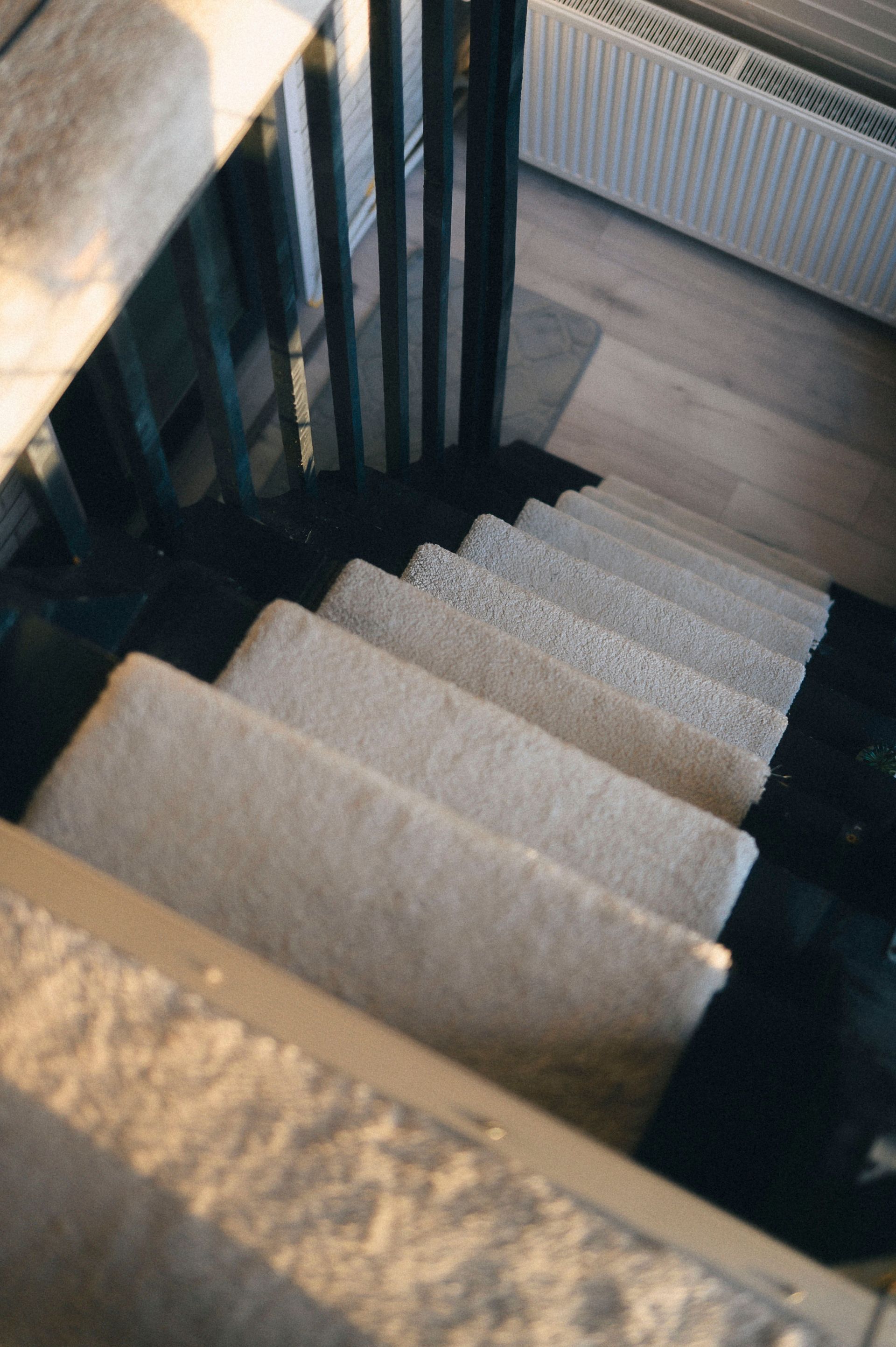
Stairs are priced differently from flat floors because every step takes its own cutting, wrapping, and fastening. If your project includes a staircase, our article on the best carpet for stairs in Utah homes covers what holds up on the nose of each step.
What Moves Your Price Up or Down
Carpet Grade and Fiber
Fiber type and construction quality drive most of where a project lands within the typical $3 to $11 market range, and premium fibers can go past it. Heavier, denser constructions and premium fibers sit at the top; basic constructions meant for low-traffic rooms sit at the bottom. We keep fiber detail out of this article and cover it on our types of carpet page.
The question worth asking is "Should I put premium carpet everywhere?" Usually not. Match the grade to the room. A guest room or a closet rarely justifies premium fiber. The hallway between the garage door and the kitchen, where winter boots track grit in every day from December through March, is where durability pays for itself.
Padding Selection
Padding absorbs impact, and its quality shows up in how long the carpet above it keeps looking good. A denser pad in a busy hallway usually earns its place more than extra softness does, while a bedroom can lean toward comfort. The underlayment article linked above goes deeper on density and thickness.
Moisture and Subfloor Surprises
Prep deserves extra attention because it is the cost most often discovered mid-project. Moisture is worth checking before new carpet goes down, especially in basements and homes built on concrete slabs. The EPA's brief guide to mold, moisture, and your home notes that mold can hide on the underside of carpets and pads, and that porous materials such as carpet may have to be thrown away if they become moldy. Finding a moisture problem before installation costs far less than finding it after. Our services page lists comprehensive subfloor preparation as included; if the estimate turns up damage that needs repair, ask to see it as its own line.
Room Shape and Access
Odd-shaped rooms, several small rooms, and furniture-heavy rooms add time to the job. We can assist with moving standard furniture as part of the installation, but heavy items like pianos or large entertainment centers may need to be moved before we arrive.
How Market Averages Compare to Your Quote
A little more context on the market figures above. They are national averages, not our prices.
Angi's guide, updated September 9, 2026, reports a national average carpet replacement project of about $1,777 from 8,740 verified projects, with most homeowners paying $780 to $2,812. Homewyse builds its estimate from retail product pricing and labor data, and it does not include work like subfloor repair or general contractor markup.
If a quote you receive lands far outside these market ranges in either direction, treat it as a prompt to ask more questions, not as an automatic deal or an automatic pass.
National averages blend every market, every product grade, and every installer. They cannot price your hallway, your stairs, or the subfloor under a 40-year-old family room. That is what the measurement is for.
Carpet vs. Other Flooring on a Budget
Carpet is not always the right answer. In moisture-prone spaces like basements, laundry rooms, and mudrooms, some homeowners comparing budgets choose LVP or another water-resistant surface instead. How well any of those floors handles water depends on the specific product and the installation, so treat waterproof claims as qualified rather than absolute. Sheet vinyl is another resilient option for utility spaces.
In many Wasatch Front homes the decision ends up room by room rather than whole house: carpet upstairs for bedroom and hallway comfort, and a harder-wearing surface on the main level where boots, pets, and snowmelt come through the door. We do not price those alternatives here. Each job is priced after measurement, and the numbers in this article are typical carpet market ranges only.
How to Read a Carpet Installation Quote Before You Sign
Before you sign anything, run the quote through these questions:
- Is the quote broken out by line item: carpet, padding, removal, prep, stairs, and transitions?
- Does it name the specific carpet product, fiber, and pad, or just a grade word like "good" or "better"?
- Are seam locations and transition areas identified?
- Does it cover cleanup and a final walkthrough?
- Who moves the furniture, and what happens to the old carpet?
A few mistakes cost homeowners more than they expect:
Comparing single-number quotes at face value. Two quotes with the same total can describe completely different projects. The line items are the comparison; the total is just the ending.
Skipping the subfloor check. New carpet installed over damaged or moisture-affected subfloor can fail early, and the fix often means doing the job twice.
Choosing the thinnest padding to save a little. Padding is a smaller part of the total than the carpet, but it has a big say in how the carpet feels and wears. Trimming the pad budget can cost you carpet life.
Forgetting to ask about furniture and disposal. These are logistics with real labor attached, and install day is the wrong time to discover them.
Residential Flooring Solutions holds Flooring Contractor License S220 and carries general liability and workers' compensation insurance. Our price match guarantee is straightforward: if you find a lower price for the same materials and quality of installation from a licensed competitor, we will match it.
Get Real Numbers for Your Home With a Free In-Home Estimate
Every range in this article is a starting frame, not a price. The only way to turn these ranges into your number is to measure your rooms, check the subfloor, and plan the seams, and that is what a free in-home estimate does. We'll measure your space and provide a detailed, no-obligation quote, and we will talk through grade and padding where they actually matter.
From our base in West Jordan, we serve homes across Salt Lake County and Utah County. To set up your estimate, use our contact page or call (801) 907-1908.
Recent Posts